
2 stocks every top fund owns + new Long Equity tools coming soon
Hello.
I hope you're having a good week. In this week's email I'd like to share with you some recent research.
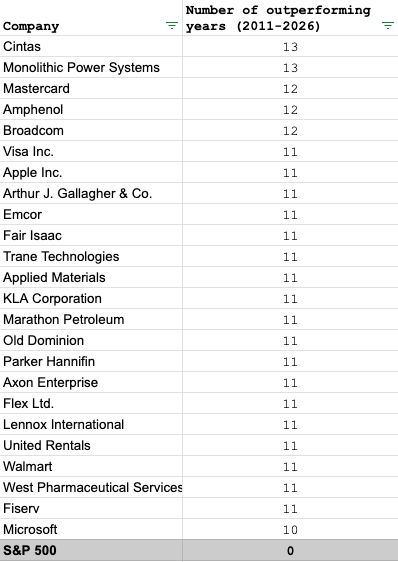
To get started, I've been looking at consistent outperformers. I recently ran a custom screen looking for companies that have consistently beaten the S&P 500. This table sorts the constituents of the S&P 500 by the number of years they have outperformed over the last 15 years. Cintas and Monolithic Power Systems are currently at the top, having outperformed 13 out of the last 15 years. From this list I own Mastercard, Visa and KLA.
Next, cash returns on capital, which is a favoured metric by many quality growth investors. While the higher the better, this custom screen determined for each S&P 500 constituent their lowest Cash ROC over the last 5 years and then sorted the companies from highest to lowest. Adobe rose to the top. Their return on capital typically averages around 65%, it currently sits at 74% and the lowest it has hit over the last 5 years is 53%. It will be interesting to see if this can continue, particularly given that Adobe appears to be most at risk of the disruption from AI. From this list I own Mastercard, Visa, KLA, Fortinet and Cadence - all of which are consistently capital efficient companies.
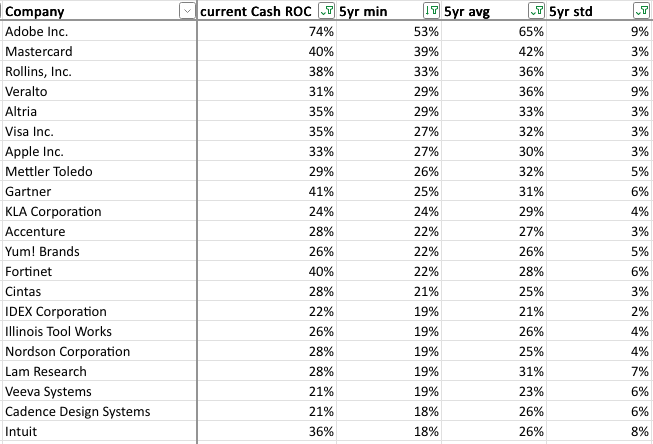
Sustaining high returns on capital over an extended period is rarely accidental. It usually points to durable pricing power and high switching costs that shield a business from competition.
One thing that may jump out at you is that both Mastercard and Visa appeared on both lists. That got me thinking, how do their financials compare side by side? In December, if all goes according to plan, I will be launching a lot of new functionality across the Long Equity platform - focused on assessing both quality and valuation. The below image is a screenshot of this functionality, which will allow you to compare one company with another.
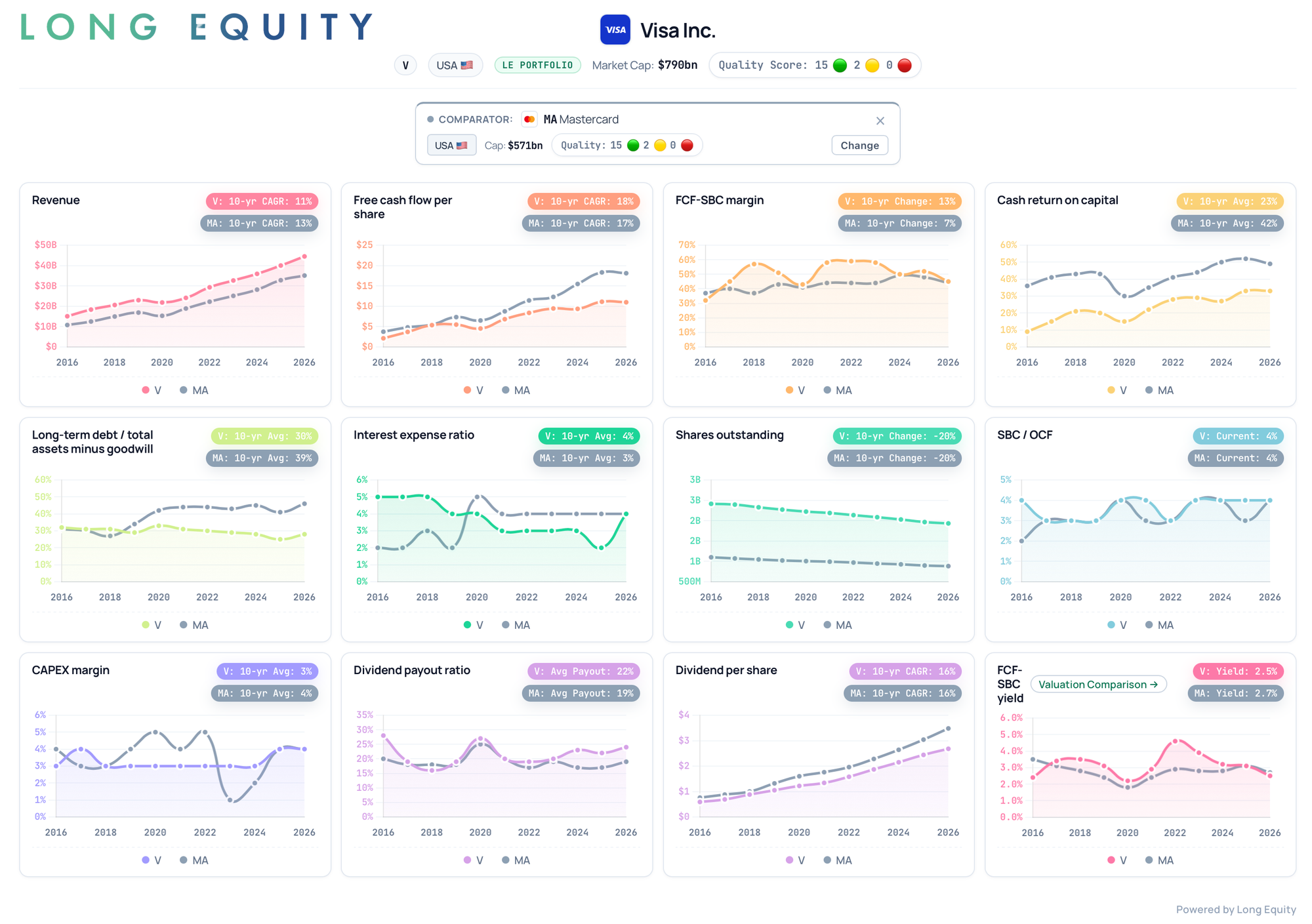
While the market often treats the two payment networks as interchangeable, subtle differences in their growth profiles and capital allocation can meaningfully impact long-term compounding
So here's how their financials compare:
- Growth: Mastercard is seeing slightly higher revenue and FCF growth than Visa.
- Margins: Historically Visa had higher margins, but the gap has narrowed.
- Cash ROC: Mastercard is the clear winner here, but Visa isn't too far behind.
- Debt: Nothing really in it. Both have strong balance sheets.
- Share count: Both are heavily buying back stock.
- SBC: Nothing in it, levels are low for both.
- CAPEX: Nothing in it, both are very capital-light businesses.
- Dividends: Both are growing their dividends at the same rate, but Mastercard pays out less FCF to do so.
- Valuation: Mastercard is slightly cheaper with a 2.7% FCF yield.
I don't personally have a favourite, and indeed, many quality investors, including myself, invest in both.
You may have spotted that there has been a recent flurry of 13F filings by top fund managers. I follow several firms, including Altarock, Triple Frond and Valley Forge. Of six firms I follow closely, the below table sets out where they overlap. And notably, both Visa and Mastercard feature in all six funds.
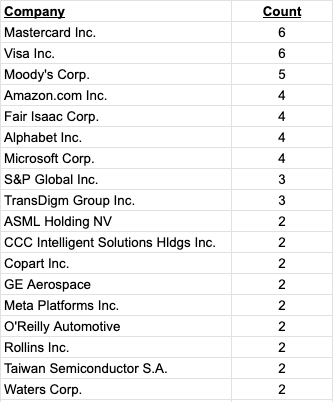
Of course, institutional ownership is never a substitute for independent conviction, though seeing this level of consensus among concentrated managers provides reassuring validation.
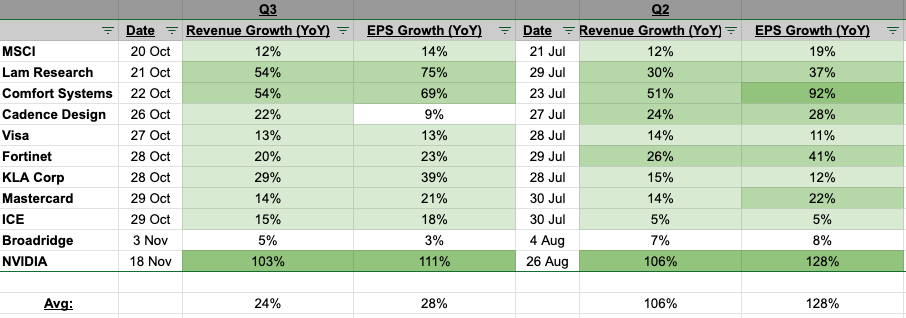
Lastly, in addition to the quarterly 13F filings, there has also been a flurry of quarterly 10Q filings. The last in the Long Equity portfolio has now come in from NVIDIA, who continue to post some of the most impressive results globally.
That's all for now, but there will hopefully be a very interesting announcement to make very soon - so keep a look out for that.
Long Equity