
☄️ Finding the future constituents of the S&P 500

Index rules vs market reality
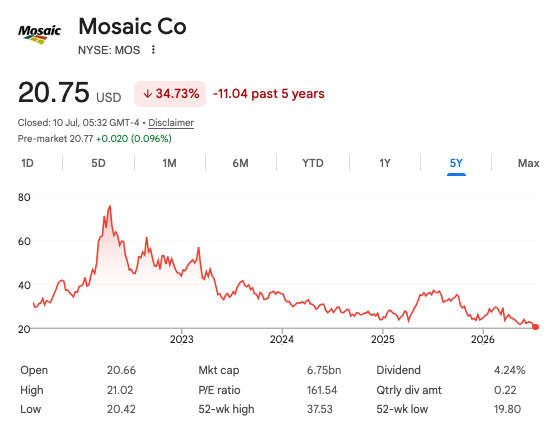
NVIDIA, with a market capitalisation of $4.7tn, is currently the largest company in the S&P 500. But what about at the other end of the spectrum? Sitting at the bottom we have the chemical company Mosaic, with a market cap of $6.75bn. That's equivalent to 0.14% of NVIDIA. Yet both are S&P 500 companies.
Mosaic entered the S&P 500 ten years ago and in recent years have seen its share price plummet.
Sitting below the S&P 500 large-caps we have the S&P 400 mid-caps. Here, Twilio is currently sitting on the top with a market cap of $33bn.
Did you notice that? The largest company is the mid-cap index is larger than the smallest company in the large-cap index.
The eligibility criteria for inclusion into the S&P 500 is currently $22.7bn (source). Now you may be wondering why Mosaic is not in the S&P 400 and why Twilio is not in the S&P 500.
That's because the criteria for getting added to the index is different to the criteria for getting removed. Here's what S&P Dow Jones Indices say about this:
"As a reminder, the market capitalization eligibility criteria are for additions to an index, not for continued membership. As a result, an index constituent that appears to violate criteria for addition to that index is not removed unless ongoing conditions warrant an index change."
The S&P Dow Jones Indices use an Index Committee (rather than an algorithm), so while it's possible Mosaic will get removed in the future, the Index Committee will need to discuss and agree to it first.
According to my calculations, there are currently 126 companies in the S&P 500 that are below the $22.7bn threshold. This reflects just how dynamic market capitalisations can be, and how slow changes to membership can be.
While you may think this would have an impact on performance, remember the S&P 500 is market cap weighted. I calculate the total market cap to currently be $73tn. The combined market cap of the samllest 126 companies in the S&P 500 is $1.9tn, or 2.6% of the index. That's why they can afford to be slow in readjusting.
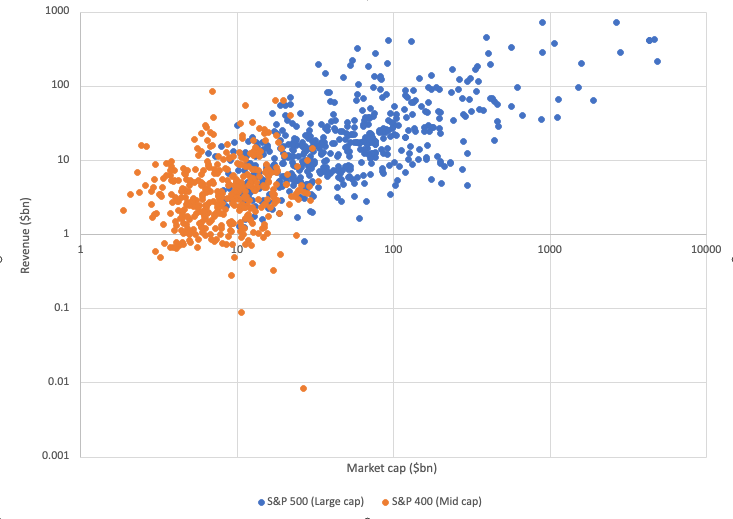
In the below table I plot market capitalisation vs revenue for the constituents of both the S&P 500 and the S&P 400. As the table shows, there's significant overlap between the two indices.
This balance between static rules and market reality recently entered the spotlight following SpaceX’s $1.75 trillion IPO. While the Nasdaq 100 adapted their framework to fast track SpaceX into their index, the S&P 500's Index Committee refused to waive their traditional 12-month seasoning period. This decision has, for now, prevented S&P 500 investors from having any exposure to SpaceX.
The mid cap re-rating thesis
What we'll try and do here is examine the S&P 400 and forecast some of the future constituents of the S&P 500.