
A Pure-Play Payments Compounder with a decent FCF yield
Moving money across borders used to demand either a suitcase full of banknotes or eye-watering high-street bank fees. What began as two London flatmates quietly swapping currencies across a private group chat has quietly evolved into a £140bn global financial rail system. Today, this asset-light compounder is systematically undercutting legacy lenders, clearing over 60% of its transactions instantaneously, and trading at an underlying 5% free cash flow yield.
New here? Unlock the full analysis below to discover the company name, our valuation breakdown, and why this global compounder could be significantly mispriced.
Origins
It is often said that the only way to truly do cross-border payments is with a suitcase full of banknotes.
In the late 2000s, two Estonians living in London had an idea:
- Taavet's employer paid him in Euros (€), but he needed Pounds (£) to pay his rent.
- Kristo's employer paid him in Pounds (£), but he needed Euros (€) to pay his mortgage in Estonia.
Initially, they used high street banks to move their money around, but noticed they were being met with large fees and foreign exchange rate spreads. They then realised they had the exact inverse of each other's problem.
The solution was:
- Taavet deposited his Euros into Kristo's Estonian bank account.
- Kristo deposited the equivalent amount of Pounds into Taavet's UK bank account.
This meant no fees for cross-border payments, as no money was crossing a border. Both transfers were cheap, as they were essentially domestic payments that Taavet and Kristo had manually coordinated. They then turned this into a private group chat consisting of other expatriates who required a similar service. They could then manually arrange peer-to-peer currency swaps.
Once they realised the opportunity, they set up TransferWise plc in 2011, which later became Wise plc. Instead of moving money internationally through the SWIFT network, Wise now has an automated platform backed by multiple bank accounts across a growing number of countries. Now, when a customer in the UK pays Pounds into Wise's UK bank account, Wise can then pay out Euros from their European bank account.
In May 2026, Wise completed their corporate restructuring and moved their primary listing onto the Nasdaq, while retaining a secondary listing on the London Stock Exchange. This dual-listing structure was designed to tap deeper US tech capital pools whilst preserving their UK and European investor base.
What makes Wise stand out?

Their proprietary network of direct central bank settlement rails, multi-jurisdictional licensing, and global multi-currency balance sheets creates a high barrier to entry that a standard fintech would struggle to replicate. They operate an asset-light, "scale economies shared" business model.
Their growing volumes are driving down unit costs and creating savings that are being passed back to users (the Costco model); this is resulting in strong customer retention and word-of-mouth marketing leading to cheap customer acquisition. Crucially, over 60% of transfers now complete instantly, creating a self-reinforcing advantage that competitors cannot match.
The growth opportunity
Both the market and Wise's share of the market are growing. Global cross-border payments are expanding at a steady 4%–5% per year. Wise processes over £140bn in annual volume and grows transaction volumes by 20% per year, significantly outpacing the underlying cross-border transfer market while taking volume directly from traditional banks.
Wise is continuing to take market share globally. In 2025, Wise generated £1.2bn in revenue, of which just 19% was from the UK. North America accounted for 20%, Asia-Pacific 22%, and Europe 31%. Asia-Pacific is now the fastest-growing region for Wise.
Wise controls an estimated 4% to 5% of global personal cross-border volume, and their share of SME cross-border payments sits at 1%–2%.
So there's a growth opportunity here.
Wise has evolved from a pure transactional remittance utility into an international financial hub. They are now integrating their platform into tier-1 banks and other enterprises, including Interactive Brokers and Google Pay. This is further unlocking distribution channels and more revenue. Through the "Wise Platform", partner institutions can embed Wise’s payment rails into their own platform, which turns potential rivals into distribution partners.
The competition
Wise bypasses SWIFT by operating their own payment rails and bank accounts, including with central banks, across multiple jurisdictions. Replicating the regulatory licences, technology, and integration creates a barrier that most fintechs would struggle to match.
Wise doesn't compete with any company operating a similar business model. Instead, they are primarily competing with traditional banks for whom cross-border payments aren't their main revenue stream.
While rivals like Revolut compete via lifestyle "super-app" features (crypto, credit, retail investing) and Airwallex targets complex enterprise commerce (merchant acquiring, programmable corporate cards), Wise deliberately avoids balance sheet risk to remain a low-cost, pure-play payment rail opportunity.
An M&A target?
Theoretically, you would expect Visa and Mastercard to both be interested in buying Wise. Kristo and other early backers hold Class B super-voting shares (carrying 9 votes per share), which mathematically would suggest that a takeover would require founder consent. Wise holds central bank clearing access and money transmitter licences in over 80 plus jurisdictions. A takeover bid by a major card network (Visa/Mastercard) or a systemically important bank could mean long and drawn-out antitrust investigations and regulatory pushback from central banks. So it's not impossible, but perhaps not likely either.
Their financials
Here's a screenshot of their financials from the Long Equity Data Terminal.
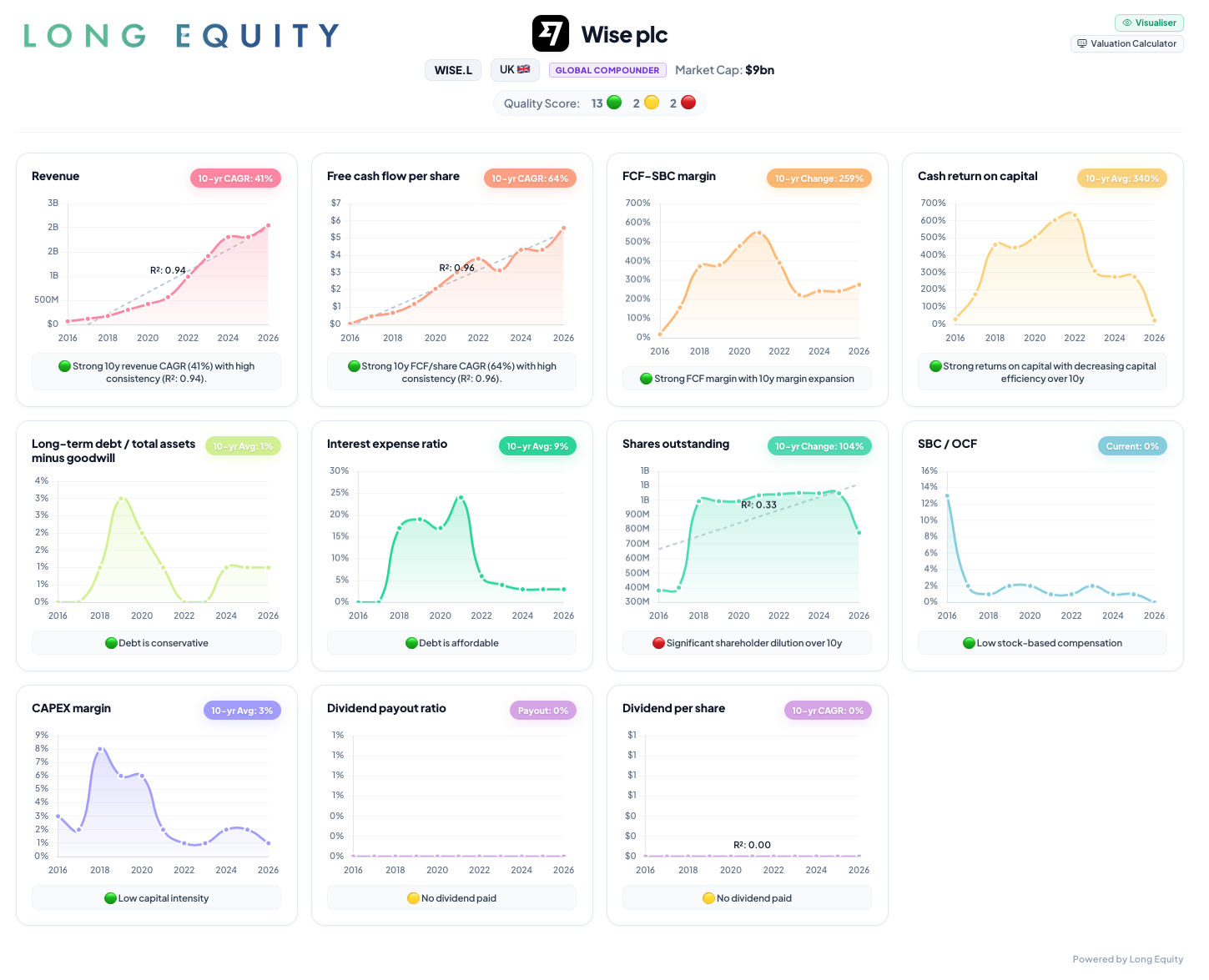
- High and predictable growth: Their high revenue and FCF growth (including the low volatility evidenced by the R^2 values being close to 1.00) shows that their strong business model is creating high and predictable growth. This is 5-star growth.
- Capital allocation: Their cash return on capital has been significantly high, and is often in the triple figures. This is further supported by low levels of debt (1% of their tangible balance sheet) and interest payments on that debt (<5% of their operating profit). In the last 5 years, they've kept their shares outstanding steady, and have recently begun buybacks. Their stock-based compensation is also very low (<2%). Overall, this is 5-star capital allocation.
- Pricing power: Margins are very high and their business model suggests that growth has primarily been driven by volumes, not prices. In fact, they've been passing on savings to their customers, suggesting that if volume growth is high and prices are coming down, there's likely to be some room to grow prices in the future, if needed. Again, 5-star.
So I can't fault their business model or their financials.
Understanding their valuation
The standard calculation for Free Cash Flow (FCF) is Operating Cash Flow (OCF) - Capital Expenditure (CAPEX).
Let's grab these numbers from their annual report.
Wise generate $7,553.9mn in OCF

As for CAPEX, we get $21.4mn.

This gives us $7,532.5mn in FCF, which is the equivalent of $7.53bn.
Their current market capitalisation is $11.25bn:
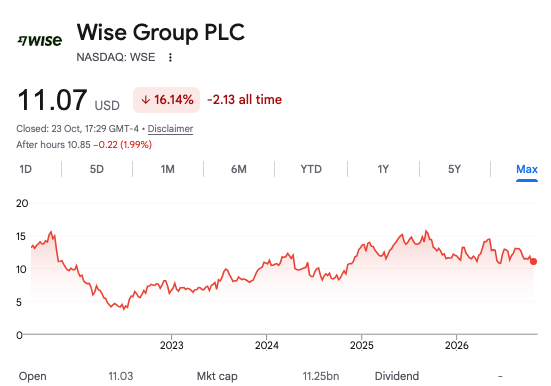
So, this suggests an FCF yield (FCF/Market Cap) of 67% (7.53/11.25).
Now, for a seasoned investor, that doesn't seem quite right! That's because for Wise, their reported OCF figure combines changes in customer safeguarding deposits and float movements. Due to their rapid growth, customer deposits have surged, meaning billions of dollars in client safeguarding float flowed through the operating cash flow statement, creating an inflated headline figure.
To find the real Underlying Free Cash Flow, we need to account for these distortions. If we start with their net income of $498.7mn, add back non-cash expenses like depreciation, amortisation, and share-based compensation (~$95mn), and then deduct our $21.4mn in CAPEX, we arrive at a corrected FCF of approximately $572mn.
Dividing this more accurate FCF figure by their market market cap gives us 5.1%. For a rapidly growing, highly cash-generative, asset-light compounder that strongly benefits from network effects, a >5% FCF yield represents a remarkably attractive valuation.
Am I going to add Wise to the Long Equity portfolio?
Currently undecided. Watch this space!